tokio has a worker thread per core, concurrency → same thread doing multiple task (context switching when one process is doing io etc) parallelism → multiple threads doing multiple task at the same time
Future (not same as Promise)
in javascript the moment we create an async functions it starts running and gives back a promise when called await till the task is done in javascript a Promise is eager
while in rust, creating async function doesn’t start executing the process rather waits for it to be called so in rust Future is lazy so to run a async “Future” we need a runtime = tokio, it converts Future to a “Task” running tokio::spawn(calling async function) makes it Future to start executing
Structured Concurrency & Cancellation
spawn vs await :
#[tokio::main]
async fn main() {
	// fire and forget task (this creates a new task)
	tokio::spawn(logging());
}#[tokio::main]
async fn main() {
// in same task
// we wait for future to complete
let user = fetch_user().await;
// now user can be used as we know for sure that it has completed
}join! vs await:
join! → better
#[tokio::main]
async fn main() {
	// in same task
	// we wait for both futures to complete
	// but this is different from writing sequential awaits
	// as join! does interleaving, i.e. if one future is doing io
	// run the second one
	let (config, db) = tokio::join!(
		load_config(),
		connet_to_db(),
	);
	let user = fetch_user().await;
}#[tokio::main]
async fn main() {
let config = load_config().await;
// wait for config future to fully finish
let user = fetch_user().await;
// wait for db future to fully finish
let user = fetch_user().await;
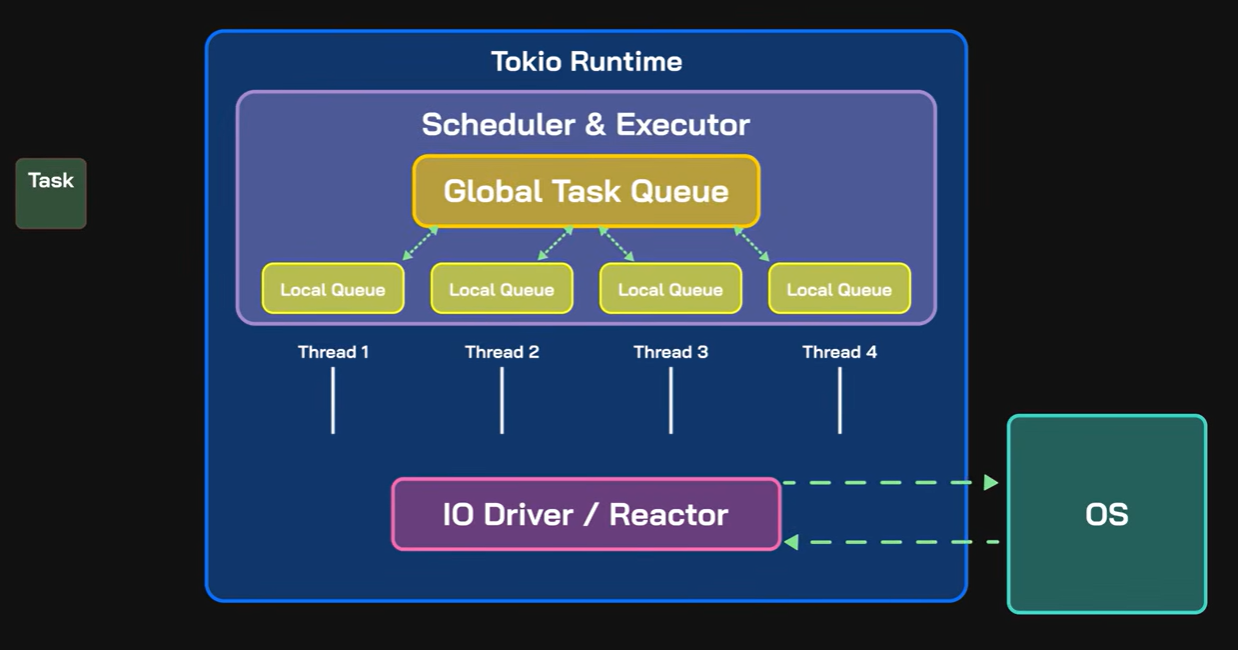
}tokio runtime
#[tokio::main]
async fn main() {
	let user = fetch_user().await();
}- Task = tokio’s unit of work
- Scheduler and Executor = picks a task (scheduler decides) and run it on a thread (has local queues or ring buffers = hot in cache so fast and have no locks, global queue absorb overflow of task)
- it allows work stealing if a thread is idle (i.e. both local and global queues are empty)
- IO Driver / Reactor (mio api) = Event driven, passes task to OS